Wojciech Boguslawski
____________________________________________________
1757 - 1829 |
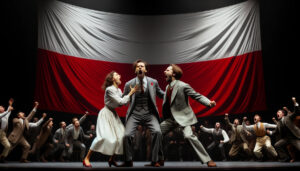
Born on 9 April 1757 in the village of Glinno near Poznań to a noble family. He attended the Piarist school in Warsaw, then enrolled in the Kraków Academy in 1770. After a year he continued his education in the Schools of Nowy Dwór. He was a frequent visitor at the estate of Bishop Sołtyk of Kraków. In 1775 he joined the Lithuanian infantry guards. On 24 February 1778 Bogusławski left the army with the rank of Officer-Cadet, disappointed with the lack of his expected promotion. That year he made his debut as an actor, an opera singer and a dramatist. The libretto of the opera Nędza uszczęśliwiona, to the music of Kamieński (staged on 11 July 1778) marked the beginning of Polish folk-based opera. In 1781 he moved to the Lwów Theatre. On his return to Warsaw, he joined the Association of National Actors, then in 1783 he was granted permission to found a Polish theatre in Poznań. Appointed the director of the Polish Theatre on 1 May 1783, he also became the director of foreign ensembles in Lubomirski's enterprise. In August 1784 he followed King Stanislaw August to Nieśwież and organised performances during the Parliamentary debates in Grodno. In February 1785 he moved to Wilno, and arranged regular performances in Grodno, Dubno and Lwów. In response to the appeal of Stanisław August Poniatowski, he resumed the directorship of the Warsaw Theatre in order to stage patriotic plays. At the time of the Targowica Confederation he came into conflict with the administration - one of the reasons for this was the staging of Henryk IV na łowach. In November 1792 he staged Voltaire's Meropa - the first tragedy to be put on in the National Theatre, then in 1793 an opera entitled Axur in his own translation, to the music of Salieri. In 1794 he joined the conspiracy led by Kościuszko, assisting the agitation by staging Krakowiacy i górale on 1 March; on 18 April he signed the Act of Insurrection; he also participated in the activities of the Revisory and Interrogatory Deputation. At the request of the Supreme National Council he resumed the presentation of performances. |
On 4 November 1794 he left Warsaw, saving the theatre property and his personal belongings. In 1795 he started his activities on the Lwów stage and for the first time in Poland put on Hamlet, in his own translation (based on a German adaptation) (1797). He returned to Warsaw in 1799 and directed the Warsaw theatre for the next 14 years. In 1801 the Prussian administration banned Bogusławski from producing performances on pain of imprisonment for the publication of patriotic leaflets. The ban was then removed, thanks to the intervention of high Masonic authorities. In 1802 Bogusławski staged Mozart's The Magic Flute and initiated the translations of tragedies by Racine and Corneille. Received by Friedrich Wilhelm in Poznań in June 1802, Bogusławski was granted the privilege of organising performances in all languages for 10 years. He arranged for the National Theatre in Warsaw and the theatre in Lwów to be rebuilt (the latter at his own expense). Thanks to his efforts, the School of Drama was opened in Warsaw in 1811. Having handed over the directorship of the theatre to his son-in-law, Osiński, he remained active as an actor and as an organiser of theatrical life. On 20 November 1827, he performed on stage for the last time in the comedy Koszyk wiśni. In 1824 he moved to an estate in Jasień, which he had taken on perpetual lease. He belonged to the Freemasons and was a Master in the lodge "The Temple of Wisdom" and was nominated twice to the Society of the Friends of Science. He gave his name to all his illegitimate children. Bogusławski died on 23 July 1829 in Warsaw. He prepared all his School of Drama lectures for print, entitled Dramaturgia, czyli Nauka sztuki scenicznej (Dramaturgy, or The Art of Stage Plays); the second volume entitled Mimika (Mimics) was not published. Bogusławski wrote Dzieje Teatru Narodowego (The History of the National Theatre), including profiles of his contemporary actors. His playwriting output comprises about 80 items, most of which are translations or adaptations, according to the convention of Enlightenment literary translation; in his own productions he based above all on English and Italian models. The work of special importance in Bogusławski's output is the comic opera to the music of Stefani, entitled Krakowiacy i górale, created in the years 1793-1794, supposedly on the initiative of the conspiracy preceding the Kościuszko Insurrection. The first-night performance on 1 March 1794 was enthusiastically received but after the third performance the opera was banned by the Tsar's ambassador and it only returned to the stage at the time of the Insurrection. Re-staged in Lwów, the opera was immensely popular, it was later constantly updated and re-staged (hence different versions of the title) and it also had numerous sequels. The text of the first-night performance has never been found, the first Berlin edition dated 1841 is based on one of Bogusławski's manuscripts. Marek Adamiec |